
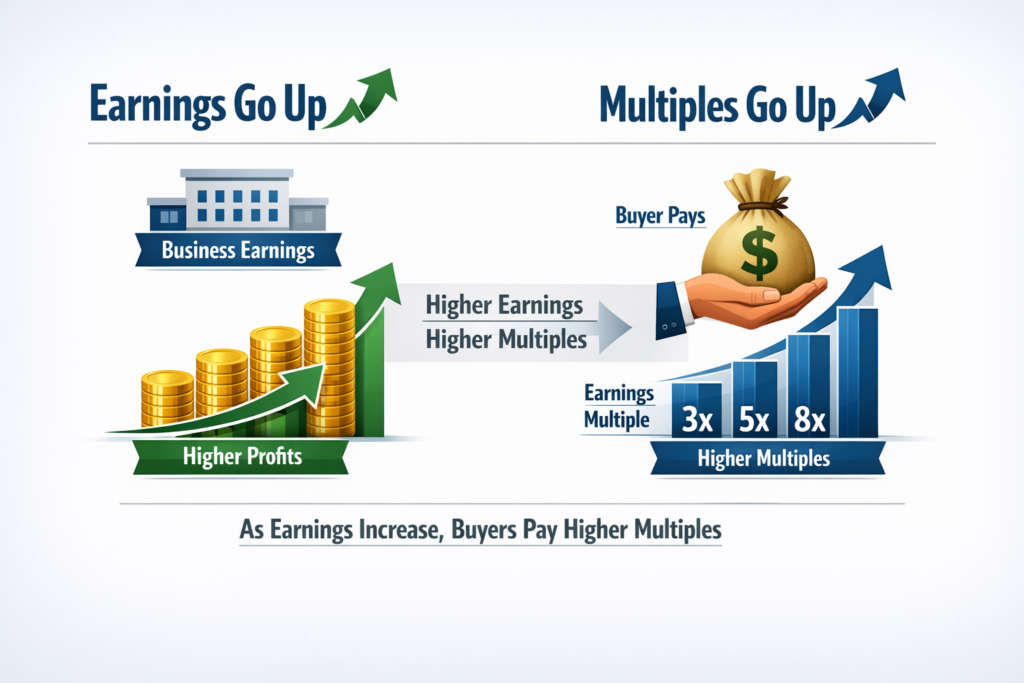
If a distribution business has $300k EBITDA on $2MM in revenue and it sells for a 3.5X multiple, then a similar company doing $10MM in revenue and $1.5MM in EBITDA should be worth $5,250,000, right? Probably not!
Businesses don’t just become more valuable as their earnings increase; they also become more attractive, more predictable, and more financeable. That’s why companies with over $1 million in annual earnings routinely command higher valuation multiples than smaller firms. In the world of business sales/mergers and acquisitions, size isn’t just a number—it’s a signal of stability, scalability, and reduced risk.
Bigger Earnings = Lower Perceived Risk
Buyers—especially sophisticated ones—base the multiple they pay on risk. A business generating $1M+ in EBITDA or SDE typically has stronger financial controls, more predictable revenue streams, better customer diversification, documented processes, and theoretically, less risk. These characteristics reduce the risk of earnings volatility. Lower risk translates directly into higher multiples because buyers are more confident their earnings will continue after the acquisition.
A Larger Buyer Pool Drives Up Competition
Small businesses (earning under $1M) are usually purchased by individuals or small partnerships, often using SBA financing. This limits the pool of buyers and caps valuations. Once earnings exceed $1M, the buyer universe expands dramatically: private equity firms, family offices, strategic acquirers, and high‑net‑worth investors, and many of these buyers don’t need or use SBA financing. More buyers competing for the same asset naturally pushes multiples higher.
Higher Earnings Usually Mean Higher Earnings Quality
Larger businesses tend to have cleaner books and fewer add‑backs or owner adjustments. They often have professional accounting, audited or reviewed financials, and a clear separation between owner and business expenses. This transparency reduces uncertainty and increases buyer confidence—another driver of higher multiples.
Scalability Becomes More Obvious
A business earning over $1M has usually proven it can scale. It has a management layer beyond the owner, repeatable processes, market traction, and operational infrastructure. Buyers pay premiums for businesses that can grow without having to reinvent themselves. A scalable business isn’t just worth more today—it’s worth more tomorrow.
Lenders Prefer Larger, More Stable Companies
Financing is a major factor in valuation. Lenders are more comfortable underwriting larger businesses because they have stronger cash flow coverage, are less dependent on the owner, and have more predictable performance. When lenders are confident, buyers can borrow more—and pay more.
Strategic Buyers See Synergies
At the $1M+ level, a business becomes meaningful enough to bolt onto an existing platform. Strategic buyers may pay premium multiples because they can reduce overlapping costs, expand into new markets, leverage existing sales channels, and increase pricing power. These synergies can make the business worth far more to the buyer than to the seller alone.
The Bottom Line
Larger earnings don’t just mean more profit—they signal a fundamentally different type of business. One with stability, scalability, and strategic value. That’s why the jump from $500K to $1M in earnings can impact the valuation multiple.